Showing posts with label game design. Show all posts

Sunday, December 10, 2017

Let's have a chat about game diffiulty

I’ve been ruminating on game difficulty some. Whilst I don’t want to go into the Cuphead debacle, I’ll concede that some valid questions were asked and we owe it to ourselves as consumers and to the game industry to try and come to a consensus, or at least to figure out what the mainstream and niche answers are.

But I’ve heard the sentiment echoed here and there that difficulty isn’t accessible, and I don’t think that’s true by default. Challenge is one of the core aesthetics of play, and difficult challenges often yield more rewards, especially if they’re fun to complete. Nothing feels better than overcoming a tough obstacle, and knowing that you only did it because you became better as a player.
But I do think that Cuphead’s difficulty does raise an important question that I think we definitely should be asking;

How do we make difficult games accessible?

Here’s a quick refresher; Arcade games were hard. They had to be in order to earn your coins. That difficulty ended up being translated to home consoles in their first iterations, and a whole generation of gamers grew up with tough games just being the norm.

Today, tough as nails games are niche. You still get the odd stand-out here and there, but games are easier, and as a result, more accessible than ever. And unless you’re playing on original hardware, even older tough as nails games are much more accessible thanks to save-states via emulators, although there’s certainly an elitist mentality in the gaming community that frowns upon the usage thereof.

But here’s my main point; Tough games can be accessible, they just have to be worth the challenge.
Touhou, Dark Souls, Osu, Hotline Miami, Shovel Knight, almost the entirety of the SNES library… These are some of the toughest games but are all so fun and rewarding that you have to ask, are we just not approaching difficulty correctly? Challenge is fun. Overcoming adversity is what’s part of why videogames are fun to play.

I think that the difficulty curve of games isn’t too often talked about. Creating a satisfying difficulty curve in a videogame is an art; If it’s too steep, the challenge might ramp up before a player can adjust and needlessly frustrate them. If it’s too shallow, the game might feel like it plateaus, which makes what is meant to be a challenge an exercise in monotony. Most games also have design oversights that can introduce spikes. The infamous Barrel of Sonic 3 & Knuckles comes to mind. A difficulty curve also changes as a player grows in skill. You’d be hard-pressed to find a Dark Souls veteran who still thinks the Asylum demon is a tough fight.

Nailing a difficulty curve is the difference between a game that gets completed and favourably viewed retrospectively and a game that gets lost to obscurity.

While Cuphead seems to be a game that, for the most part, handles its difficulty curve competently, the entry barrier is also a tad thick. Each game has a skill floor and a skill ceiling. The skill floor is the minimum amount of skill required to produce competent play, and the skill ceiling is the maximum skill one can acquire. Usually, any given game wants to have a low skill floor, and a high skill ceiling. Make the skill ceiling too low and mastering the game becomes unsatisfying. Make the skill floor too high and the price of entry is too high for most casual players.

One aspect I think a lot of developers don’t consider is screen real-estate; The more you fill up the screen with, the more information you give to the player, the more likely sensory overload is to occur. Admittedly, this is usually more of a problem with Bullet Hell and Shoot ‘Em Ups than with any other genre, but I’ve seen it occur within platformers. Any given clip of high-level play in Touhou looks like a rave and an acid trip all mixed into one. High-level Osu can be just as daunting. But if you give the player too much visual information before they’ve reached a certain skill level, you’ve effectively neutered their ability to play. If you don’t have practice reacting that quickly to that many on-screen objects, your brain might do a derp and you could make a mistake that you’d usually avoid. Snoman brought up the idea of how poor use of screen real-estate can actually lead to a detrimental experience in a game, and introducing too many elements at once can definitely cause a player to leave a game unfinished.

Inaccessible difficulty can come from another place; Poor frame rate and sloppy controls. If your game feel is awkward and clunky, you’ve added a new dimension of challenge, and PC gamers know how awful playing at less than desirable frame rates can be (although I still think the standard should be 60 frames per second and not 30 frames per second). The common example brought up for control is coyote time or the ghost jump. The extra few frames after leaving a platform in which you can jump. Some platformers extend the player’s collision box in order to achieve this. Others code a short timer, but either method creates the same result; responsive controls.

Long iteration cycles also come to mind. This comes in two parts, the time between the fail state and a point where new progress can be made, and the time taken for a fail state to reset. Both should always be as short as possible. Re-treading old ground too often is never good, and lengthy death animations that boot you to the main menu can just find the nearest garbage bin to climb into. It’s cheap difficulty. It’s artificial.

Telegraphing is also important. Telegraphing is the act of conveying information to the player, whether it be their current objective, or that an attack or obstacle is incoming. Nothing sucks more than a game with a bad case of “where the heck do I go”, and being hit by something off-screen you could never see coming just is poor game design.

Here’s another thing developers might not consider; Effective teaching tools.

How you convey the ins and outs of your game’s mechanics are the way that it teaches the player. I’m not talking about Hbomberguy’s play-conditioning, although it certainly forms part of this. I’m talking about the effectiveness of your tutorials, the resources available, the way lessons are taught. Older games had extensive manuals, the original Final Fantasy famously has an 80 page guide to get you through the first half of the game. Dark Souls is an interesting case in that while there are in-game tutorials, the community itself is the teaching tool. Guys like Vageta311 release tutorials using mined data, many players release build guides, there are hundreds of walkthroughs and of course, the notes on the ground from other players. Games don’t come with manuals anymore, so the way players are taught is essential in making a tough game more accessible.

While this is by no means comprehensive, other aspects to difficulty might just be quality of life; clearly visible boss healthbars, level progress meters, recommended level before attempting warnings, cancel-outs from combos. Stuff that might make the game easier, but also just make it that much more accessible to play. The idea isn’t that you rig the game against the player; you should be giving them a wall that you want them to conquer, even if it is by repeatedly mashing their heads against that wall until it falls over.

From this, I think in order to create a game that is tough but accessible, I think the following conditions should be met:


  • There should be a satisfying difficulty curve
  • There should be a relatively low skill floor, but a high skill ceiling
  • Effective use of screen real-estate
  • Solid frame rate and tight controls
  • Short iteration cycles
  • Clear telegraphing
  • Little quality of life additions
  • And just a fun game

Fun is subjective, but players will power through any game if the aesthetics are pleasing and the gameplay is fun. Tough isn’t necessarily inaccessible. We just have to be smart about the way we create difficulty and resist the temptation to be cheap.

If nothing else, just include a guide on how to get barrels to move up and down, please.

Tuesday, May 23, 2017

Screen Crunch; A Handful Of Problems

When porting games onto a handheld, or even sometimes when designing graphics without proper communication with the programming team, a fun little thing happens where a game can literally be made too large for the screen it's going to be played on. We've all been there, we've all felt the icy sting of being hit by enemies and obstacles you can't even see;

The magic of Screen Crunch.

Now I thought this might be only be an issue affecting handhelds and retro games, but hey, it happened a whole bunch in the life cycle of the PS2 and sometimes it even happens on modern consoles.

Usually screen crunch happens when a game made for a system intended to be played on a large screen is ported to a system with a much smaller screen, and thereby "crunches" the player's field of view. Less often, graphical assets are made too large for the available on screen pixels, and thereby making less screen visible. To illustrate, here's Sonic The Hedgehog on the Sega Genesis/Mega Drive versus Sonic The Hedgehog on the Game Boy Advance.


Image result for sonic the hedgehog genesis gba

And here's Sigma Star Saga for the GBA, a game with sprites wayyyyy too big for the GBA's screen.


This immediately adds a layer of artificial difficulty, since the player has to now react to objects they can't even see. In some games it's worse than others, ie. turn-based RPGs aren't going to show the same difficulty spike due to screen crunch as an action platformer.

The easiest way around this is to, of course, design smaller assets, and adjust physics accordingly.

The unfortunate downside is that smaller sprites don't often sell games.

Graphical fidelity is a marketing moneyshot that the publishing industry has to rely on to push products. After all, you can't physically play a game trailer, you can only look at it, and if it doesn't look good, it won't sell. I think gamers have unfortunately adopted the mentality of appreciating graphical fidelity over visual aesthetic.

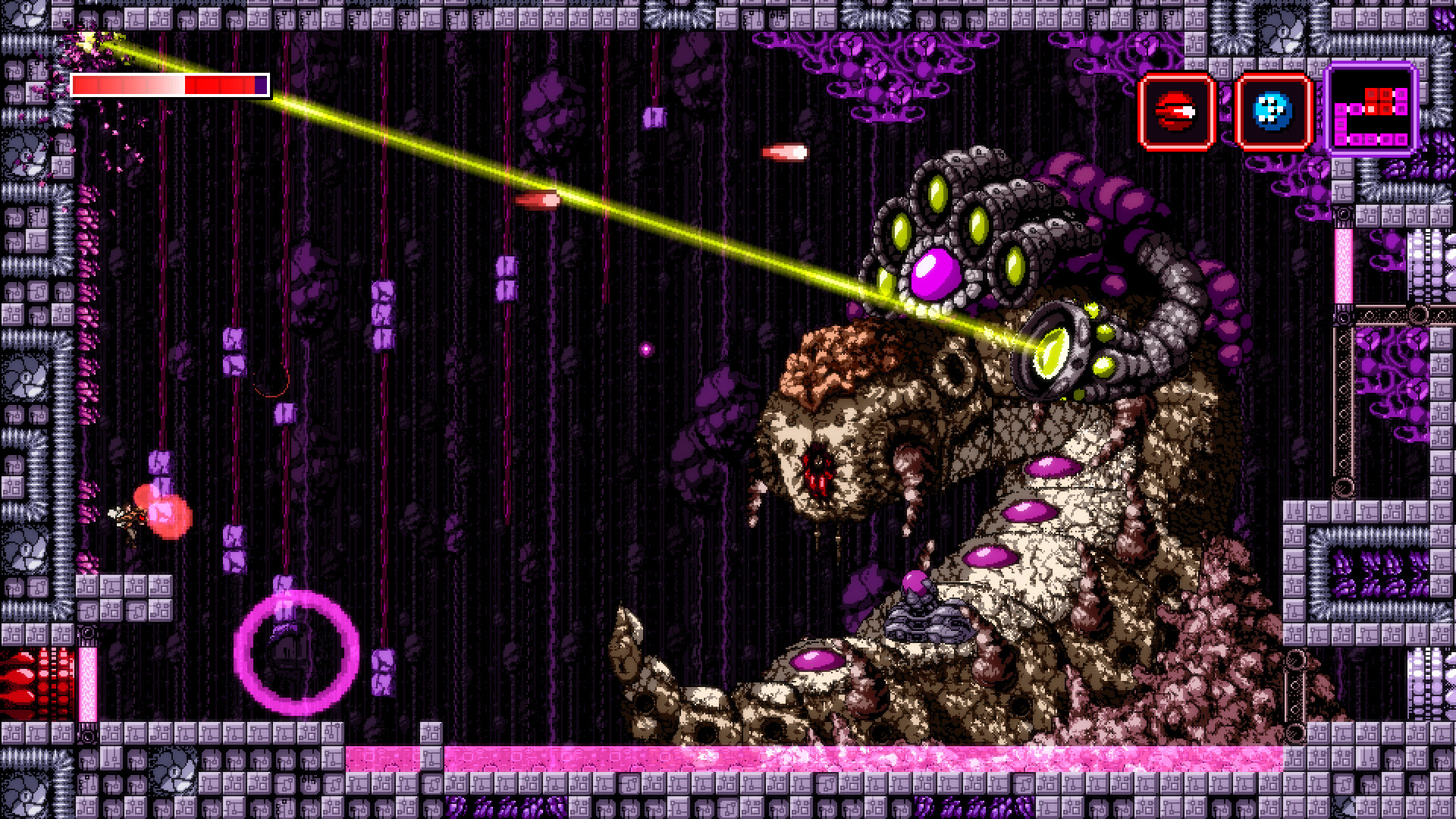
But that has changed! Look at indie metroidvania game Axiom Verge, which make excellent use of HD screen space and sizes down the sprites, while upping the mechanic prowess of it's protagonist.


Yes, that little speck of  a person is you. And the advantages of this is that you *always* know when an enemy or obstacle is incoming and you.

I think this is something to always keep in mind. And while graphical fidelity is always nice, it should never come at the expense of your game's mechanics. And while it's easier to simply aim for higher resolutions and absurd amounts of anti-alias and millions of on-screen particles and polygon counts that you need a calculator to reach, sometimes you can achieve the same level of engagement by simply using a better colour palette, more striking character designs and some thought through world-building.

Visual aesthetic is going to always trump graphical fidelity. It's basically the entire selling point of Nintendo games, they sell consoles with last generation hardware but make characters and games so iconic that they can compete with modern triple A titles. Case in point, Super Mario 3D World on the Wii-U is much less graphically intensive than The Witcher 3, but the two reached nearly the same level of critical acclaim (SM3DW reaching scores of 9 to 9.6, with the Witcher 3 reaching scores of 9.3 to 10).

That's right, PC gamers, a Wii-U game reached the same level of greatness as one of the juggernaut games on the personal computer, and did it while wearing a furry cat costume.

So when designing your own games, just remember, you don't need to be a graphical juggernaut. You don't need assets that take up that much screen space. Just make a good game and give it its own flavour and quirk. Visual Aesthetic sells just as well as graphical fidelity.

And above all, let us poor gamers see the fucking bottomless pit coming.

Friday, May 5, 2017

Sonic Generations; Possibly the only Sonic game you'll ever need to play.

**The following post is a review I did on another blog I had that I have since shut down, which might explain to why it feels dated or different. I simply decided that it wasn't much worth throwing away.

Following the one thing those dudes from that one Game Review site we all love to hate had said (TL;DR version, IGN has a YouTube segment, a couple guys started talking about the 25th Anniversary party and the tease for Project 2017 and Mania, and then one of the blokes uttered, and this is not verbatim, "Sonic was never good.") I feel like I should probably bring up the one (of the few times, including Colors which IGN rated 8.5/10 so kinda dropped the ball there gents) that a Sonic game was just really, undeniably, unnervingly good.

So, in 2011 it was Sonic's 20th anniversary, and considering how his 15th Anniversary game went, you'd be justifiably skeptical about Sonic's future. At the time, the fantastic albeit just unfortunately Wii exclusive Sonic Colors had been released just one year before, and the surprisingly not terrible Sonic Unleashed (also known as King of the Framerate dips) had graced the world with their existence. The potential was there but would Sonic Team pull it off?

Yes.

In spectacular fashion. I cannot praise this game enough. It has rocketed me towards death more times than I can count, the final boss fight was subpar and underwhelming at best and honestly the game has the originality of a Twilight joke in 2016 (a little like this review actually). But to list all the great things about the game would take ages. But I think I'll talk about the game from a different perspective rather than the usual Gameplay/Graphics/Story/Soundscape format. It's boring, you can go find it anywhere and if you need a recommendation on whether or not to pick up the title I can simply give you a "fuck yes, be on your merry way and enjoy the adventure you little rascal."

But if you're still here with me, let me dive into the meat of it all here.

I wanna talk about Game Feel first. A kind of meh term to be honest but I can't really come up with a better one and far be it for me to try and sway the nomenclature of the world. But the question I want to ask is how exactly does it feel to play Sonic Generations?

Fantastically.

Let me first address the classic gameplay segments. There's a recurring problem I have with all the classic Sonic games, including the untouchable and ever fault-less Sonic 3 & Knuckles. It's the amount of weight Sonic had. I mean, he was a little tubbier back then but Imagine if you pressed on the accelerator of a car hard enough to feel the pedal touch the mat. Now imagine that whether or not that pedal was floored or only slightly touched, you'd still only accelerate at the same, painfully slow rate. That's what it felt like playing classic Sonic games. The issue is that Sonic felt like he never has any urgency, he starts at 0 and then slowly climbs his way to top speed, which is hella fast, don't get me wrong, but classic Sonic was always more about keeping momentum than quick reactions. In Generations however, this isn't the case. Sonic feels lighter, more carefree, and much faster. The camera is zoomed way out so you have plenty of room to see what's ahead. While it isn't perfectly up to scratch and you find yourself in Crisis City experiencing the worst of it due to this wind mechanic that honestly makes me see flames and curse the existence of Sonic The Hedgehog 2006 even more, but for the vast majority of the game, it feels fucking fantastic to zoom through stages, trying your hardest to get a good run and reacting as well as you can to the spikes and pits and enemies. In addition to remaking classic stages in a way that not only feels fresh but stylizing them to look absolutely gorgeous whilst allowing the player to witness the spectacle of it all, the modern stages are given the same treatment, putting them in 2.5D and Seaside Hill is the one that feels just the best. There's a point where you will end up on a certain lane if you lay a certain way but you can still see the other in the background and this kind of horizontality would have been impossible in the classic games, and the use of the z axis just goes such a long way into making the levels feel like a real place. Another fantastic improvement and I would be extremely poor to exclude is the choppers. In the original Green Hill Zone and in all subsequent games, the choppers are all dangerous hazards from the moment the appear on screen. However, in generations, they're safe for the first few frames where they jump up behind the bridge and only become a danger after reaching the fullcrum point of their jump and then dive down onto Sonic. It's small but it makes such a huge difference. Finding all five rings in Planet Wisp let's you unlock a homing attack for Classic Sonic but I never felt it was necessary. I never felt like at his most basic, he felt like he needed something more. And I think it goes to show how timeless the classic Sonic formula is.

And now that we've gotten the boring fluff out of the way, let's talk about the real star of the show. Modern Sonic. Sonic as he is today. One issue that I am so glad didn't carry over from Unleashed is the problem unleashed had with lanes. Quick stepping with Sonic in Generations is always perfect and I am baffled at just how tight the controls are every time I play. But onto the feel.

The game does so many things to get the feel of Sonic right it's just hard not to put the controller down, take a second to just marvel at what you just saw, pick the controller back up and jump in for more. Let's start with the boost mechanic. It's a simple matter of variable x + Sonic's current velocity. However, the sound effect, that satisfying little boom that plays along with the sound of the air gushing past your face and the ripple that flashes across the screen as it happens, the gorgeous effect around Sonic, and something people don't often notice but Sonic normally runs really loosely, with his hands trailing behind his body and his head kind of bobbing with each step. But when you boost, he clenches his fists and leans in just a bit and Sonic just looks like he's enjoying the act of raeching his top speed. I really have to commend the animators on their work here because it's just so freaking stellar. The transitions between 3D and 2.5D is also just so seamless and you begin to understand why Sonic Team took away manual camera control. And the spectacle? Man, it's just ramped up. Jumping away from the Mega Chopper trying to nom you as an afternoon snack is just one of my favourite moments in the game and  the best part is how you can perform tricks, practically taunting it as you get away. The game is a power fantasy combined with the experience of an adventure through this brightly coloured world.  It's wonderful. Unbelievably wonderful. Sonic's moveset is just a joy to work with, combining the stomp with the boost and air dash to perform complex and timing based manuevers to beat a record in the best time possible, that's where it's at. The grading system at the end also only encourages one thing; speed. Beat the level as fast as you can. It's not unbearably difficult to get an S-Rank and you'll find yourself playing the game over, and over, and over until you finally perfectly beat that one stage. I found myself, even after getting an S-Rank, clearing all the challenge missions and finding all the Red Medals just replaying Green Hill Zone act 2, to get the best time, learn the secrets of the stage, and just unwind at the end of a long day blasting through a fun stage that's so superbly designed that based on the minute and a half it takes to complete it alone, I'd give this game a perfect numeric score.

And you want to know what else provokes those positive emotions? A full orchestral soundtrack remaking classic chiptune songs into massively scaled musical pieces that just brings the game together so nicely.

It kind of shocks me how easily people forget this game when saying things like "Sonic was never good." I mean, the game's story is extremely simple and doesn't overstay it's welcome. The few times you sit through the cutscenes you'll find yourself marveling at just how well the engine runs them. They aren't prerenders, and I think that says the most about them. But Sonic Generations is not just a good Sonic game, it's just a great videogame. I can just recommend it to anyone. I can just smile and say, play this game. Just pick it up and see what it's about and give it a bit of love and Sonic Generations will love you back. It'll be your friend when you're down and your rival when you need to prove yourself. This game is a lot of things, In this world, there exists no such thing as perfection, but Sonic Generations comes so close I'm willing to give it a mulligan.

Friday, December 9, 2016

A Rumination on Sonic Heroes; It's Kind of Underrated.

Not often does a game come by that makes you stop, pause and think, “Huh, you know what, that’s actually a pretty clever.”

And Sonic Heroes is somehow, against all the odds, one of those games.


Sonic Heroes is a 2003 PS2, Dreamcast and Gamecube game (with a lost Australian PC port that is very hard to get one's hands one, believe me) that sold reasonably well and was on release received very well, but as it aged more and more people started just hating the game, roasting it as if it were a 12 year old beauty vlogger posting her first video and utterly failing on camera.

Now it's not hard to spot that the game hasn't aged very well and truthfully it's a little unfair on the completionists (and may Segata Sanshiro have mercy on whichever poor fool attempts a 100% on a Sonic The Hedgehog game) but I haven't played the game since I was a wide eyed child and it wasn't until recently that I picked up a copy of the game that I could truly see it for what it was;

A rough around the edges masterpiece that deserves more love then we give it.

I will admit to my own bias here. I'm in love with the idea behind the game more than the game itself. On paper, this is the most well designed, conceptually brilliant action-platformer I have ever had the pleasure of just swirling about in my brain. And if it weren't for this game solidifying Sonic The Hedgehog as the cornerstone of my childhood gaming experiences, I'd probably be a very different person today. But if you'll allow me to gush for just a second, I promise, I do eventually get to talking about the great game design in Sonic Heroes.

Trying to articulate the plethora of thoughts I have about it is almost impossible. Every time I try, a new idea pops into my head. While the final product may barely be worth an IGN approved 7/10, teetering dangerously close to 6 or maybe even a 5, and while Railway Canyon munched through my lives faster than any of the teams could blast through with Sonic speed, I have put this game down, picked it up, put it down, sat up thinking about it at night and picked it up again in a vicious cycle.
As a kid, this was only the second or third Sonic game I actually played. I remember being wholly nonplussed by having to play as Sonic’s shitty friends and kinda just wanted, well, a Sonic game. And whilst I didn’t hate the game, when I received the PC port of Sonic Adventure DX, I had a much better time with Adventure, owing much to the fact that I never bothered finishing anyone’s campaign other than Sonic’s in Adventure and thereby preserving the mirror polished sheen of nostalgia I have for the game. I finished Team Rose, 70% finished Team Sonic, 40% finished Team Dark and barely touched Team Chaotix. I’d never really had much of a drive to return to Sonic Heroes but once my PS2 died and I had gotten better at playing videogames and learnt more about game design, I thought that I definitely owed it to myself to revisit it. But I still delayed playing it. I don’t really understand why but I wanted something new. And it wasn’t until I had picked up and dropped Sonic Unleashed, purchased Sonic Adventure 2 off the PSN and gotten the Sonic Humble Bundle and finished Sonic CD that I thought, now is the time.


So a funny thing happened when I booted it up. I’d always had a gigantic soft spot for Sonic Heroes’ theme song. It’s cheesy, wasn’t very well mixed and definitely dated, often called straight up garbage by many fans but somehow, I knew all the lyrics to that fucking song. All of them. And is the intro cinematic played out I screamed them along.

Okay, so maybe I liked the game more than I thought. But I mean, this game just aged poorly, it's definitely not as great as I remember it being as a kid. Hell, I didn't even like it that much as a kid, I liked Shadow The Hedgehog more because I was an edgelord shucklefuck with bad opinions.

But then I went into Seaside Hill WHICH IS STILL ONE OF THE BEST DESIGNED SONIC LEVELS OF ALL MOTHERFUCKING TIME HOW IN THE HELL CAN ANYONE EVEN HATE THIS GAME (more on this in just a moment).

And then Ocean Palace came, and still. Sure, some control and physics issues popped up but nothing game breaking. The water looked gorgeous and the world was vibrant and all these bright colours were on the screen and Sonic Heroes was hitting all the right notes in a scarily tight rhythm.

And that's when it hit me.

It's not just my nostalgia.

I've gone back to games before and hated them, even if I loved them as a kid. I've gone back and recognized my own biases many times before and still loved games that I knew were utter filth (looking at you, Sonic Adventure DX). But this, this wasn't bad. This was great. This was amazing. This was, dare I say it... Perfect. Of course I did have to face reality when I managed to remove the nostalgia facehugger impregnating me with sparkling eyes and an inability to notice genuine flaws, and it wasn't perfect, and of course, I eventually did manage to get an less biased and better thought out view of the game, but the first three levels is just honestly fantastic. I can't gush enough. But anyway, I'm going to move away from the nostalgia boner hardening in my pants as I write this because Seaside Hill, and maybe Seaside Hill alone, subverts the Sonic level design formula in such a brilliant way that it still blows my mind to this day and I need to meet Yuji Naka and hug the man for his wonderful contribution to the world.

So for those of you who don't know, the rule for any given Sonic game is high path is best path and low path is death path. You're encouraged to stay on the higher, faster path and rewarded for the skill you display by managing to stay on it, but punished for bad play in the slower, much more "platformy" lower path. The bottom of the stage usually has the most spikes, pitfalls, long stretches of slow and tedious platforming, water, enemies. While I do appreciate the nuance of the logic, where you're forced to get better at the game by having to do more challenging sections in the bottom of the level that teach you more about the game's mechanics and intricacies of controlling a meth addict blue hedgehog, it's almost a guaranteed trap for newbies. You will fall into the bottom, and because it's so easy to fall to the bottom, it feels like the game is subtly corralling you towards the lower path but in truth the game is trying to challenge you to stay high, the route which guarantees the fastest clear time and most secrets.

Sonic Heroes takes that formula and says fuck you, here's how we do it.

So Sonic has always had a very natural difficulty select built in. Tails is easy mode because flight let's you get back to the top. Knuckles is intermediate mode, because he glides and can climb walls, so he's how you get to know the levels the best and explore without being burdened by tail's flight limit. Sonic is 'hard' mode, since he takes the most skill to use, is the fastest, but he offers the most rewarding gameplay. 

Sonic Heroes then took that concept and threw it right into the very level design of the game. 

So you control Sonic, Tails and Knuckles all at the same time, or rather you control one of the three at any given time and the other two are delegated to being two AI nincompoops who for the most part stay out of your way and sometimes even help you get shit done faster, and you switch out who is the "leader" aka, the character you control. Each character comes with their own unique team formation. When Sonic leads, everyone gather behind him in a straight line and runs in his slipstream. This is the fastest way to get around and is dubbed Speed Formation. When Tails is the leader, the team forms in a totem pole formation to make it easier for Tails to take off at a moments notice. This is called Flight Formation. When Knuckles is the leader, he literally uses his best friends as either fucking boxing gloves to pound everything from the environment to enemies, or he curls them up into balls and hurtles them as hard as he goddamn can into the ground. This is Power Formation. You can also glide in Power Formation, by performing a "Triangle Dive", but unfortunately you can't climb.

Got all that?

Now the whole level is designed to modulate the difficulty, pace and aesthetic of play to which formation you end up playing in most.

Like speed running and fast paced platforming challenges? Play in Speed Formation and you'll get taken through super hazardous super fast routes with loops and twists like the rollercoaster a Sonic game should be. Need to take it slow and explore the level? Play in flight formation and you'll do more platforming but it's slower and easier to navigate. Like brawling? Play in power formation and you'll have plenty of enemies and destructables to abuse like Michael Jackson's dad abused his kids. 

So instead of High Paths and Low Paths, you have Speed, Flight and Power paths. You can easily change from one to the other and you can play as any formation on any path, and often certain sections demand a quick change in order to progress. The greatest thing about this fluidity is that it asks the player to use the game's mechanic's creatively to find the optimal route through the stage. There's a whole lot of replay value because your runs don't ever look the same as you take different turns and change to different formations. The mechanic of formations create a fluid dynamic of path finding and platforming challenges but create three entirely different aesthetics. I think I jizzed in my pants a little writing that sentence. 


I lie awake in bed at night thinking to myself "Fuck me, who ever designed Sonic Heroes is just really fucking brilliant." The complex dynamics the mechanics form, the nuanced gameplay, the variety, the creativity, I just swirl it around my mind and wonder how anyone can so easily write this game off.

And I think now would be the best time to talk about my criticisms of Sonic Heroes, or rather, everyones criticisms. Because these are huge errors, and it says so much that I can honestly call this game a rough around the edges masterpiece knowing full and well how bad some of these are;

The physics is garbage.

For one, Sonic moves just a little too fucking fast. Or rather, he accelerates too quickly, you shove the analogue in any direction and he goes and rockets off without consent, blasting through with Sonic speed when a brisk walk would have done just fine. The problem is as much with the acceleration as it is with the deceleration. You have to run in a tiny little circle once you've asked permission from the board to stop and filed the proper paperwork because there's no real way to stop yourself dead in your tracks. But at least Sonic will stop when he reaches the edge and do a little edge pose.

Power characters will slide right the fuck off.

Ground combat is also for the most part worthless, considering that you could slide right off the edge midway though a combo and if you don't like a power character (I'm fucking glaring at you, Big the obnoxiously voiced Cat) too fucking bad. You need him. Every member of your team is vital because some obstacles can only be overcome by certain members. Since only the power characters can glide, they're the only ones who can use the fans to rise to higher platforms. 

Other than that, the major criticism and missed opportunity I must bring up is that you can't change formation mid air.

I dream of the day where my team all homing attacks in unison onto an enemy, we change mid-air so that tails can fly us up, and from as high as we can, we use the triangle dive to reach a far off platform safely.

I understand that the scope of the levels would be changed and the size of some of these levels are already fucking huge, some taking well over ten minutes to finish.

But damn if it isn't a nice dream.

Sonic Heroes isn't just a great game, it's a proof of concept, a show that unlike his contemporaries, Sonic doesn't only work well in a team, that's where he works best. The team formations create interesting platforming scenarios and if we just had better spaces to play in and slightly better physics, I honestly think Sonic Heroes could have been one of the greatest games of all time, it might even have put Sega back into a place where they were a dominating force in the gaming industry.

But alas, it is not so, and Sega hasn't voiced any plans to make a sequel or a reboot of the the game, which is a crying shame. 

All in all, the soundtrack is phenomenal, it's a Sonic game, that's a given at this point, the levels are well designed even if they get more linear as the game goes on and while I miss hubworlds and the chao garden from Sonic Adventure, they aren't necessary.

All in all, I do find it tough to recommend just because it is a Sonic game, but if you can stand the roughness, honestly, it's a great fucking game.

But play it in sessions.

Because they shitty physics will kill you dead, and even I rage quit no less than six times.

Thursday, December 8, 2016

Saints Row, and how to properly manage spectacle creep

"It was too crazy for Saint's Row."

As I neared the completion of the Enter The Dominatrix DLC, after having my mind fucked sideways in a dirty alley without a condom, I had an odd thought; Somehow, for four (and a half) games, Saints Row has managed to constantly churn out these batshit crazy third person open world GTA parodies that somehow are actually really good.

On paper, I'm pretty sure the design document of any Saints Row game simply states;
"Make it like Grand Theft Auto, but throw in the craziest scenarios you can think of, toss in huge set pieces and then tie it together with ridiculous character creation. Add a dash of whatever seems to be popular this year."

Saints Row 2 had that Need For Speed; Underground visual aesthetic. Saints Row The Third threw in a bit of Just Cause with some Left 4 Dead, Saints Row IV threw in Prototype. Gat Out Of Hell threw in a dash of mediocrity (honestly should have just been DLC man). But the spectacle of it all never wears out. It's like one of those carnival freakshows, you keep coming back just to see if it has anything else that's so unimaginably weird that you just stare agape and wonder how much cocaine was involved. But let me get to the point.

So when you're making the sequel to a film, book, game, play, whatever you can think of, you have to deal with the inevitable spectacle creep. "The stakes are heightened as they've not only Taken his daughter, but they've also Taken his wife." Every new iteration has to have bigger explosions, bigger bad guys, bigger blue sky holes, larger amounts of CGI alien soldiers to fight, epic battles in space... But there's a ceiling. You cannot keep rising.

So how have they managed? Well, I have to assume at least some cocaine is involved. Look, after driving into oncoming traffic with a tiger in the shotgun seat, fighting zombie clones of a giant russian man named Oleg, after riding velociraptors out of a computer simulation, after beating Santa Clawz with the actual fucking north pole, after jumping out of a plane and hijacking an airborn a tank while shooting hostile skydivers, after going to hell and shooting the ever living crap out of Satan whose daughter had fallen in love with you, after preventing nuclear war and becoming president, after fighting sentient toilets, beating up mexican wrestlers with sex dolls, after beating up prostitutes and gimps with gigantic weaponised dildos, even you'd question the sobriety of whoever the fuck even wrote this shit.

In all fairness, try spending an afternoon just coming up with insane scenarios. Try right now. Just start with Abe Licoln, a Batman cosplayer and a barrista who curses like a sailor but has a soft spot for fluffy kitties, and ask, what's the weirdest thing these three could get up to? Maybe fly to the moon and witness an alien orgy gone wrong. Or visiting the city of Atlantis but accidentally starting a civil war over whether are friends or food. They could get trapped in a computer except it's running Windows XP and every ninety minutes a different teenager comes to wack off to hardcore porn and they have to fight off the malware being downloaded onto the hard drive.

That's just off the top of my head.

Saints Row has embraced spectacle and made it a selling point. Saints Row may have started as "GTA, but batshit", but it's quickly become an acid trip monstrosity that is full of cheap thrills and just enough substance to lose hours to. And it has, for the most part, pretty tight gameplay. For all of the parts that make it a Grand Theft Auto clone, at least mechanically, those parts are always done really well. What also carries us through all the insanity is a somewhat revolving cast of genuinely likeable characters, from the ever cool Johnny Gat, to the chronically sarcastic hacker Kinsey Kenzington, to the adorkable Matt Miller and even Keith David, no connotation needed.

Saints Row is trying to sell insanity and Spectacle Creep is its ally, not its weakness. I'd wager the first order of the day in the writing room is to push the spectacle all the way to its ceiling and tone it back from there. Instead of aiming to go crazier than what came before, aim to go as crazy as possible and then compressing it all into a gang management sim slash Grand Theft Auto clone and suddenly you end up with a solid game with tons of replay value and a word of mouth marketing campaign that includes a bunch of people inadequately trying to describe how crazy Saints Row is. All the character customization and the vibrant city to explore and the cars and gang operations is the just the platform it's delivered on, and you see the progression of the game through its history there, in the dynamics, and not in the presentation.

The other thing you can do is also sell the same game every year with a fresh coat of paint and never try to innovate or push the ceiling or break the mold in fear of a fanbase that only worsens with its expectations as time goes on, but who am I to question the giant that is <Assassin's Creed/Fifa/PES/Call Of Duty/Gran Turismo/PGA Tour/NBA/Any EA sports game ever made>

I guess the take away from this is that more games should experiment just for the sake of experimenting, but we shouldn't get caught up in just delivering bigger and better. It's okay if you just deliver better. It's okay if you scale down the size of your city but tighten up the gameplay and sell the player off as a sex slave as cover for infiltrating an organized crime syndicate. Doing insane things every once in a while is what makes life worth living. But don't do insane things just to be the bigger better iteration of yesterday's game. Approaching the design of your sequel with this in mind is a pitfall many creators fall into, and it's how franchises end up at that point of uncertainty, where they no longer have an identity. Look at the scope of any trilogy of Marvel films. It just widens until you have to ask the question; "We've saved the world, where do we go from here? How do we increase the stakes?"

Saints Row is still asking the question "Is it too insane for Saints Row?".

Thursday, November 10, 2016

The Gamification Essay I Never Got To Write

Okay, a little background. In one of my university modules I was tasked with writing an essay. At the time I frowned upon the idiots around me who couldn't tell gamification from Grand Theft Auto if one of them bettered the school system and the other riled up controversy for the murder of prostitutes. So I opted for copyright law, the one I at the time had more knowledge and experience with. Since then, I have watched so much Game Maker's Toolkit, Extra Credits, PBS Idea videos, read papers on Mechanics, Dynamics and Aesthetics, played a whole lot more videogames and realised that I could write the ever loving shit out of the gamification essay, so that's what I'm going to do, except for the fun of it. Now, I could actually go write this in a super academic sense with citations and everything BUUUUTTT THAAAT'S REAALY BOOORING so I'ma just wing it, this is a personal blog and I'm just here for a good time. This might be a little long winded but you know what, I got a lot of shit to say and no word limits or goals.

Anyway so let me start by what I mean by Gamification and a little bit more of a focus on what the topic is. I'm going to be talking about Gamification in regards specifically to a school and university environment, how it can be applied to studying. I'll be using a lot of more out there game design theory, and the field is relatively new so any terminology I use could be outdated already since it is being advance literally every second I write this piece. However, most of it should still be relevant.

Anyway, let's dive right in.

The first thing I'll say that education isn't a game. If it were, it'd be the ET on the Atari 2600 of modern games. It fucking sucks. Universities, most highschools, prep schools, middle schools, they're all still using *really* outdated teaching methods and honestly this shit might have worked 20 years ago, but we're at that new age point where we're preparing students for jobs that don't exist yet. It's an incredible time to be alive and the fields of study are progressing so the way we study them should progress as well. In this very formal blog post (puts on monocle and sips tea) I'll be approaching schooling as if I were designing it like the game I've always wanted to play.

The first issue I'll tackle is iteration time.

Iteration time is basically the time it takes to get from a fail state, to a state where you can try again. A lot of older videogames took a whole bunch of pride in murdering your ass. There'd be a big Game Over screen and then you'd be taken back to the title screen and then you'd have to reload a save and URRRGH it's frustrating. Thankfully the practice is more f a remnant of a bygone era now. These days you'll die in some World War 2 based shooter, time will rewind and you'll be put moments before you got killed. Bioshock especially doesn't even respawn the enemies you killed. Prince of Persia will literally rewind time to right before you messed up the jump. So what's the iteration time of schooling right now? Well, if you fail a test, you can't retake it. If you fail a subject, you have to wait 365 days to retake that subject. Imagine if you failed a level in a videogame and it said, no no no, come back in a year when you've gotten good, scrub. Fucking learn some pro strats before you walk up to me with that weak ass shit again.

I'd say, fuck this game, I'm going to go play some Super Meat Boy, Why bring up Super Meat Boy? Well I'm glad I asked so you didn't have to! I'll link to Mark Brown's episode of Game Maker's Toolkit on redesigning death, which is my primary inspiration for this part of the essay. Okay, here's a link to a Let's Play of Super Meat Boy, specifically around 3:33, Jacksepticeye dies. But pay attention. Notice, he died, the screen fades for about a second, and he's immediately at the start of the level.

The iteration time is half a second long.

Now, iteration time in games can be used to control the flow and pace of a game. Sometimes it's used to evoke a certain feeling. Dark Souls especially likes to evoke the feeling of existential dread and insignificance, and likes to remind you, in BIG BOLD RED LETTERING that you, have in fact, died.



That's no fun, is it? Imagine after every botched test the world went dark and in bold red lettering it spelled out YOU FAILED. At least Super Meat Boy doesn't taunt you, it doesn't make a huge fuss, you died, try again.

Now imagine you're taking a math test, and let's say it's electronic and multiple choice. You've just answered say six out of ten questions incorrectly, which is a fail.

However, instead of just grading you and failing you, what if the screen faded to black, put you at question one and said try again?

This is a concept known as motivational punishment, and I'll let Snowman Gaming tell you all about it in his video. The point is to reset the game from a fail state as quickly as possible in order to make sure the player is not discouraged by their death but motivated to try again as the opportunity is quickly and readily available. Why wait 365 days to retake the test that cost you passing the semester when right after you fail, you could take the test again, and again, and again, right until you got the grade you needed. While someone could probably find a better solution to the problem, I'm here mostly to point out flaws and create a starting point. Currently, in the game of educatin' yo'self, you have to wait a pretty long fuckin time to play again after you "die". So the iteration time needs to be lessened dramatically. Also, it'd be nice not to put anxiety fuel messages on out student portals like "Did not qualify for exam entrance". That shit is just hard to look at man, it hurts deep.

Anyway but say we've cut down the iteration time. What else seems to be plaguing our game? It's nowhere near that IGN 10/10 so what else can we do?

Let's talk about Game Feel.

While Dark Souls is still fresh in our minds, what feeling is the game trying to evoke? In other words, how does it feel to play Dark Souls? Now this is an inexact science, I'll readily admit that. For the most part, it's pretty hard to nail Game Feel. But what it comes down to is a dumbed down formula of control plus atmosphere. So, how does it feel to learn in the modern schooling system?

If this website is to be believed, Suicide is the second leading cause of death for kids ages 10-24. That's pretty fucked up. Every day I hear at least one person out of my fellow Computer Science students make a joke about jumping off the Humanities building. Let's face it, it's fucking stressful. Worse, it's needlessly stressful. We can do so much better! Let's start with the problem that for some reason we think our classes need to be these strict learning environments that are prim and proper.

In highschool, I remember my math class having a board at the back with Demotivational Posters. They were huge back when the internet was new but it always managed to make me laugh. There. That's Game Feel. The environment was made less oppressive and stressful by a couple funny posters. Now, I will hold back no blows, I fucking hate math. I'm bad at it, it never feels intellectually stimulating, it's been one field of study I've never had any interest in. Unlike logic puzzles or memorization puzzles, is none of those. It's simple enough when you understand the rules and common solutions, *but is unsolvable if you know neither*. That's how it always felt to me, anyway. However, I'd been doing really poorly at the start of grade 11. But the point my grades picked up was pretty significant. I was sitting next to my best friend in class, and something amazing happened.

I started singing a Panic At The Disco song.

It was just stuck in my head, and we had worksheet in front of us, and I couldn't give a particular fuck on that particular day so I was jamming to this Panic song while doin' mah math. But my mate was also particularly into Panic At The Disco. So he sung along.

And that is how the math class jam sessions were born.

My grades immediately picked up because while doing our work, my best friend and I were just humming our favourite jams. It was crazy. But the learning environment had changed. My math class was no longer this dreaded place of failure, it was where my best friend and I went to have a good time. There. Game Feel. It felt rewarding to do math because it didn't feel like a chore anymore. By simply adding music. Ta da. The power of the arts everyone. Get that art degree, make fine art, change the world. We need artists as much as scientists.

The important takeaway here is that music can change how you feel in any situation. It can change how you feel about about doing a certain task. And that's the takeaway. You can change Game Feel by simply changing the music. And you can change how learning feels by adding some sweet tunes.

Now, Game Feel also comes down to how it feels to control your character. It feels super fun and bouncy to jump around as Mario, but Ezio has a decidedly harder time trying his best to reach for ledges and making these stressful perfect jumps where one misstep could lead to bone breaking painful death. The avatar you control also plays a huge role. For example, when my mate was playing Saint's Row IV, I looked at the game and thought meh. It's okay. Doesn't look great but oh well, I might try it if it's on sale. And then it was, and lo and behold, do you know what a difference it made to play with my own President? The thing is, when you play with an an avatar you yourself designed, when you get to make a fashion statement, or just run around in comfy clothes, it changes game feel. You feel more comfortable with something familiar to you than you do with the moldy testicle that you play as in Dark Souls (until you reverse hollowing but with the amount of death in that game, get used to seeing your desiccating wrinkled ass running around)

This is why I personally vouch for abolishing uniform. Now this applies more to Private Colleges and Private Schools but you can't exactly feel comfortable in uniform. You can't pick out a cute outfit or dress up as a naked obese clown. And honestly, I feel very comfy when dressed as a naked obese clown.

The long and short of it is that how it feels to be in a learning environment should feel fun. It should feel like playing a Mario game. Just look at Super Mario 3D World. It just looks fun to play and feels good. It has good game feel. And as a caffiene dependent vegetable, I can tell you straight that uni has garbage game feel. But here's a video from Cagey on the subject of Game Feel (watch both parts, it's really good).

Lastly, a lot of game feel also comes down to how the game responds to your input. Like the sound it makes when your fist connects with some punk's jaw in Streets Of Rage or the vibration in your controller when you're firing a gun while playing Call Of Duty. It should feel good to succeed at Uni and School. So instead of this pitting us against each other crap with top student and trophies, I'd just love it if every time I learned something new and useful, that little Zelda jingle played. You know the one.

Now that we've talked about Game Feel, and now that I've mentioned Mario, you know what Universities and Schools could use a little more of?

Dat sweet, sweet invisible tutorial;

In the original Super Mario Brothers, the first level teaches you so much about the game. It gives you a lot of space to figure out the controls, the first Goomba moves slowly and gives you plenty of time to react, and overall it's so iconic that it's stuck around and is used as an example of good game design to this very day. Here's another Mark Brown video on the subject (his voice soothes my soul). Snowman also does a video on the subject, which he titles Teaching Without Teaching (by the way, Shovel Knight is just fucking fantastic. If you haven't played it, I highly recommend you do). This is just a concept that could be littered EVERYWHERE in schooling. From applications in the design of the campus, to introducing new themes in a specific subject, the invisible tutorial is a powerful tool.

All that's really required to make it work are a safe space in which a concept is introduced, control is never taken away from the student and they can learn it at their own pace, everything should be introduced one step at a time to keep the student from being overwhelmed and the environment should be designed in such a way that the student reaches the conclusions they need to naturally. This is a little harder for me to try give an example of how to implement since I'm not good enough at any of the things I'm studying to set up such nuanced learning experiences, but I'll tell you about a dissection I did in the ninth grade for Biology.

So, I'd never worked with a dead animal before, I was pretty much clueless and really, I wasn't even good at Bio. But my teacher was genuinely some kind of genius because the way she managed to teach us was pretty brilliant. So we were put into groups and each group had a sheep's head and we were each told to remove a part. First, she did a small demonstration, with safety procedures and all. From observation, I learned how to hold most of the equipment we'd be using. Next, we all got a turn to remove a piece. I was on his eye, and it was pretty tricky to remove. But there was also  all these posters on the walls with anatomic diagrams and helpful tips. So when I was stuck, all I had to do was look around and the answers were right there in front of me. At the end, we had to do a small report and I remember feeling really great that from that little practical experiment, I had learned a whole bunch of new body parts, the names of different pieces of equipment, how to use them, the safety procedures and all that. It felt good to learn that day. And I wasn't treated like an idiot either. I was given all the tools I needed to succeed and the knowledge was a byproduct of just a little experimentation in a carefully controlled experience.

I didn't even know I had just went through an invisible tutorial. It wasn't an hour long lecture on how safety and then on body parts. It was hands on, and practical. I could see what I was suppose to learn and I had to apply it. A concept was introduced, I had a safe space to play around with it, and then the knowledge I gained from the experience was tested. Bam.

There's a certain feeling you get from it. Like the game itself wants you to beat it. The game isn't indifferent to your presence, it wants to be played and it wants to challenge you and it wants you to overcome its challenges to it can present you with more complex ones. And I just don't think schools ever try really instill that feeling into students. You're a student number, they say. You pass or fail by your own hands. You have to be here. You have to do this amount of work to pass. Study at least this amount of hours per week. Some of the greatest videogames of all time would never even have been given a second thought if they locked all the fun behind studying their mechanics for six hours a week.

So we've talked about Iteration Time, Game Feel, Invisible Tutorial. What else? I mean, this is just the tip of the ice berg. I want to talk about the two golden accomplishments of gaming, Speedrunning and  100% completionism.

So for those who don't know, videogames have built up quite a culture around running through games as fast as possible. There's a real mastery shown in players who can take a six to seven hour experience and cut it down to about 24 minutes. Games Done Quick is a convention where gamers stream their speedruns and the money raised goes towards charity. It's great fun and some of the things gamers do at these events are honestly just ridiculous. My favourite is a three hour speed run of Metroid Fusion and Metroid Zero mission using the same input. It's insane, a game that took me hours upon hours to finish due to all the deaths, someone can finish in three hours WHILE FINISHING ANOTHER GAME AT THE SAME TIME. It's these feats that stand out and really make the community stronger, and what's great about them is that they can be replicated.

So, why not let us speedrun subjects? If I can learn first semester psychology in three weeks, should I not be allowed to do so? You always hear about those wizkids who finished two years of highschool in one, but honestly, if we were allowed to learn and then write off certain subjects, I think a whole lot of people could do it. Now, speedruns also have certain conditions, there are any percent speedruns which just means anything goes as long as you can get the credit sequence to trigger as fast as possible, then there are 100% runs, which means you must complete any and all objectives in the most timely fashion for the run to count. This is the more useful method as anyone can barely pass four tests and an exam in four weeks. But like winter school, where you devote several hours a day to a subject and try get it all in at once, then write an exam afterwards, we should allow students to go through different courses at different paces. We owe it to them to respect their intellegence as such. Some games even offer little rewards for doing this. Although I don't think we need to show kids a naked Samus Aran for running through geography as fast as they can (that is a dated reference, friends).

As for completionism, this bounces off what I said about iteration time. What if you could get 100% for a subject? Sounds great, right? If you got 99% on a test, what if you could retake it right afterwards and then try again and again until you got 100%? Kind of like getting all the achievements in a videogame. Welcome to Completionism. Guys like Jirard have built carreers upon playing games until they see that sweet 100% on their save files. Check out anything he's done, I'll link his channel here. Imagine you could do this with school subjects, especially ones you really enjoy? Imagine taking all the tests back to back until you get a passing grade, then spending the rest of the semester gradually retaking those tests until you know all the answers and can get 100% for them and 100% complete the subject? That sounds like so much fun. I love it when games reward you for this. Additional content, secret endings, bonus levels, tougher dungeons... It's just feels great when you put in the extra effort for playing all there is to play of a game, it gives you a little something for your troubles. This'd be a great thing for studies. Recommendations for jobs on your permanent record, scholarships, anything of the nature. Everyone has that one game they're willing to sit through all the tedious side quests and shitty missions to complete 100% just because they love it so damn much, so why can't we do it with university subjects? (time constraints for starters) But I just feel like every student could benefit from gamification to this extent.

*EDIT: My friend Joshua reminded me of a really important part, and that's the motivation to play any videogame. Which is also about the motivation to finish studying. In his words:


" A big change needs to be made with how teaching is done at all levels and how we motivate kids and students to get them to really succeed, as a fear of failure is not enough to motivate people to do so. If the motivation you're using for subjects in highschool or varsity is "if I pass it gets me closer to never having to do this subject again" then there is a problem."


So there are about eight or so core aesthetics of play and most games build themselves around two or three of those (the best generally fulfilling about five or six games, and go home and test this with each of your favourite games, it really does work). Ideally a game should encompass all of them, but realistically people play different games for different reasons. They could include a mode in Banjo Kazooie that appeals to the hardcore WW2 era FPS crowd that puts you in first person mode but most designers know to rather do really well with one aesthetic than to half ass three. To name them, it's Sensation, Fantasy, Narrative, Challenge, Fellowship, Discovery, Expression and Submission. There's an Extra Credits episode that can explain it way better than I can (Linked here:https://www.youtube.com/watch?v=uepAJ-rqJKA)

So to get a student to be motivated for any particular subject, you'll probably have to design it around one of those aesthetics. Let's take History for example. We can start with Submission which is Game as Past Time. It's incredibly easy to just sit down in front of the History Channel or Extra History, tune out after a long day and just watch that kind of thing for the fun of it. It's really fun to listen to the story of Hannibal Barca trek through the alps to fuck with Romans. It's an incredible story. You can watch Historic films or such. You can turn a subject like History into something as easy to do as playing Candy Crush or Angry Birds. History can also fulfill the aesthetic of Discovery, which is Game as Uncharted Territory. For example, let's say you have a huge list of significant events in history you have to learn about. Each time you learn about an event, it gets ticked off. So kind of like filling in a map in Diablo by walking to an area in it, you can "fill in" this timeline of significant events in History by learning about it. History also by default fulfills Narrative, Game as Drama. It literally writes itself. You want to know what happens next in a great story, and we as a species have literally created so many just by doing what we do, which is living. I refer again to Hannibal trekking through the alps on the backs of Elephants to fuck with Romans. It's an incredible story and as long as it's told well, you wanna hear more of it.

With motivation, it does come down to whether or not the student is into what aesthetic a subject can fill, but if we treat subjects like game genres, there's also no reason any student can't have a great time learning any subject. I don't like First Person Shooters but I love Borderlands and Portal and Dr Brain and Mirror's Edge. A lot of people don't like Zelda, but they loved the hell out of Darksiders (which is a Zelda clone in every sense of the word). I'm not a fan of Grand Theft Auto-esque sandboxy games, but I put in a stupid amount of hours into Saints Row IV.

With enough work, any subject can attract any student, it just needs to fulfill *one* of the aesthetics that student is drawn to and boom! Motivation to learn.
I love games. Hell, everyone loves games. If I could use my love for games to broaden my horizons and increase my knowledge I sure as hell would. And while not every idea in contemporary game design is particularly useful, gamification of education could educate generations of kids who would otherwise be left behind in the modern school system because it simply doesn't account for them. There are dozens more ideas I have and honestly, I'm just a little sick of writing this essay and you're sick of reading it so I think, maybs, let's call it a day here. But Gamification could do so much for us.

Perhaps its time we really start consider using it to change the way we learn.

I still wanna go to campus as a naked obese clown though, just saying.